
Why Pickleball Players Forget the Score?
If you have played pickleball for more than a few games, you have probably experienced this moment: everyone gets into position, the server holds the ball, and suddenly someone asks, “What’s the score?”
Sometimes nobody knows.
It may seem strange because pickleball games are relatively short and the scoring numbers are not particularly complicated. Yet forgetting the score is extremely common, even among experienced recreational players.
There are several reasons for this, ranging from the unusual three-number scoring system to the mental demands of fast rallies. In this guide, we will explain why pickleball players forget the score, how pickleball scoring works, and several simple ways to avoid confusion during a match.
Pickleball Scoring Requires More Attention Than It Seems
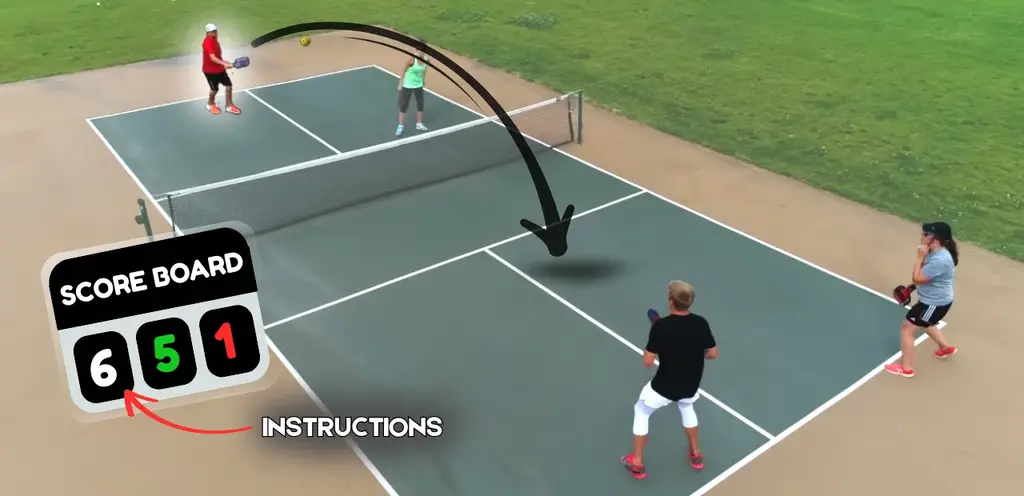
Traditional pickleball doubles uses three numbers when announcing the score.
For example:
7-5-2
The first number represents the serving team’s score.
The second number represents the receiving team’s score.
The third number tells everyone whether the team’s first or second server is serving.
That third number is one of the main reasons pickleball scoring can become confusing.
In tennis, players mainly need to remember the game score. In basketball or soccer, a scoreboard usually keeps track of everything. But in recreational pickleball, players often have to remember not only the score but also whose turn it is to serve.
This creates an additional mental task during the game.
Reason 1: Players Focus on the Rally Instead of the Score
Pickleball can move surprisingly quickly.
During a competitive rally, players may be thinking about:
- Court positioning
- Their opponent’s movement
- Where to place the next shot
- Whether to attack or reset
- Staying out of the kitchen
- Communicating with their partner
- Preparing for a speed-up
After a long rally, remembering whether the score was 6-4 or 7-4 may not be the first thing on your mind.
The brain naturally prioritizes information that feels immediately important. During the rally, that means reacting to the ball rather than remembering numbers.
Once the rally ends, the score may already have disappeared from short-term memory.
Reason 2: Only the Serving Team Normally Scores
Traditional pickleball uses side-out scoring.
This means that only the serving team can normally earn a point.
If the receiving team wins the rally, they do not necessarily receive a point. Instead, the serving opportunity changes.
This can create situations where several rallies happen without the score changing.
Imagine the score is 5-4.
The serving team loses a rally.
Then the second server serves.
They lose again.
The opponents begin serving, but they also lose two rallies.
Several rallies may have occurred, yet the score could still be 5-4.
Players sometimes subconsciously associate winning a rally with receiving a point. Because that does not always happen in traditional pickleball scoring, it becomes easier to lose track.
Reason 3: The First and Second Server Can Be Confusing
In doubles pickleball, each team normally gets two service opportunities before the serve passes to the opposing team.
This is where the third score number becomes important.
For example:
4-3-1
means the serving team has four points, the receiving team has three points, and the team’s first server is serving.
If the first server loses the rally, the score becomes:
4-3-2
The score itself has not changed.
Only the server number changed.
For newer players, keeping track of this can feel unnatural.
A player may correctly remember that the score is 4-3 but forget whether the team is on server one or server two.
That can eventually lead to confusion about who should serve next.
Reason 4: Players Change Positions During the Game
Pickleball players move between the right and left service courts depending on their team’s score and who is serving.
When everything works correctly, a player’s court position can actually help them determine the score.
But during casual games, players sometimes accidentally stand on the wrong side.
Once that happens, the positions no longer provide a reliable clue.
A simple positioning mistake can quickly turn into a scoring argument.
Someone may say:
“I thought I was supposed to be on the right.”
Another player replies:
“No, you’re supposed to be on the left because the score is even.”
And suddenly all four players are trying to reconstruct the previous five rallies.
Reason 5: Long Rallies Disrupt Short-Term Memory
Long rallies can be mentally demanding.
Players make dozens of small decisions in only a few seconds.
Should you dink?
Should you speed the ball up?
Should you attack the backhand?
Should you move forward?
Is the ball going out?
This cognitive load can temporarily push less important information—such as the score—out of working memory.
This is similar to walking into another room and suddenly forgetting why you went there.
Your brain did not permanently forget the information. Its attention simply shifted somewhere else.
Reason 6: Pickleball Is Very Social
One of pickleball’s biggest attractions is its social atmosphere.
Players often talk between rallies, joke with opponents, discuss previous shots, or chat with people standing nearby.
That social interaction is part of what makes recreational pickleball enjoyable.
But it is not great for scorekeeping.
Imagine finishing a rally at 7-6.
Someone makes a joke.
Another player talks about the incredible shot they just made.
Someone asks about a paddle.
Thirty seconds later, everyone prepares to play again.
“What was the score?”
The conversation interrupted the mental connection between one rally and the next.
Reason 7: Players Sometimes Say the Score Too Quietly
In pickleball, the server is expected to announce the score before serving.
However, recreational players sometimes mumble the score or say it while facing away from the other players.
That defeats one of the most useful scorekeeping tools in the game.
Announcing the score clearly allows all four players to mentally confirm it.
If someone believes the score is incorrect, they can correct it before the next rally begins.
When players consistently skip this step, disagreements become much more likely.
Reason 8: Fatigue Makes Scorekeeping Harder
Mental performance declines when players become tired.
After several games, especially in hot weather, concentration can drop significantly.
Players may begin making simple mistakes such as:
- Forgetting who served last
- Standing on the wrong side
- Calling the wrong score
- Forgetting whether they are server one or two
- Forgetting which team won the previous rally
This is especially common during long recreational sessions where players may play several games in a row.
Physical fatigue and mental fatigue often occur together.
Why Experienced Players Forget the Score Too
It is tempting to assume that only beginners forget pickleball scores.
That is not true.
Experienced players can lose track as well, especially during intense rallies.
The difference is that experienced players usually have several ways to reconstruct the score.
They may remember:
- Where each player started
- Which player served first
- Whether the current score should be odd or even
- Which side of the court they should occupy
- Who won the previous rally
Understanding court positioning makes it much easier to solve scoring confusion.
The Odd-Even Position Rule
One of the best tools for remembering pickleball scores is understanding the relationship between score and position.
At the beginning of the game, each team’s starting server begins on the right side.
Whenever that player’s team has an even score, the starting server should normally be on the right side.
When the team’s score is odd, the starting server should normally be on the left side.
For example:
Score 0: starting server on the right.
Score 1: starting server on the left.
Score 2: starting server on the right.
Score 3: starting server on the left.
This pattern continues throughout the game.
Experienced players often use this rule to determine whether the announced score makes sense.
How to Stop Forgetting the Pickleball Score
Fortunately, preventing score confusion is relatively easy.
Announce the Score Clearly
Before every serve, say the complete score loudly enough for everyone to hear.
For doubles, that means saying all three numbers.
Instead of quietly saying:
“Six-four-two.”
Say it clearly:
“Six, four, two.”
That small pause between numbers makes the score easier to understand.
Mentally Repeat the Score
After each rally, repeat the score to yourself.
For example:
“Seven-five. We are still serving.”
This simple habit strengthens your short-term memory.
Use Player Positions as a Backup
Learn the odd-even positioning rule.
Eventually, you will be able to look at the court and quickly recognize whether something seems wrong.
This is one of the most valuable scoring skills a recreational player can develop.
Avoid Long Conversations Between Points
There is nothing wrong with talking during recreational pickleball.
However, if scoring confusion happens frequently, confirm the score before beginning a conversation.
For example:
“Okay, it’s eight-six-two.”
Then continue talking.
When everyone returns to play, there is much less uncertainty.
Use a Scorekeeper When Necessary
Some pickleball facilities and tournaments use electronic or manual scorekeeping systems.
There are also portable pickleball scoreboards and scoring accessories that can be attached near the net.
These can be useful for tournaments, competitive practice, or players who frequently forget the score.
For casual games, however, learning to track the score mentally is usually more convenient.
What Happens If Players Disagree About the Score?
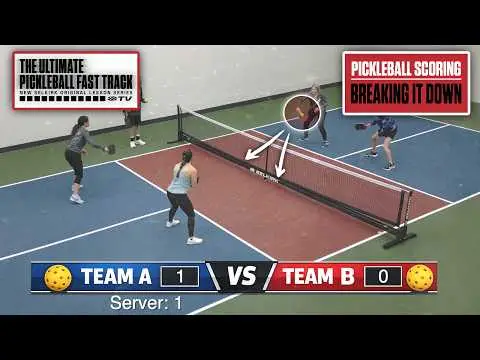
In recreational pickleball, players should usually stop and calmly reconstruct the previous rallies.
Start with information everyone agrees on.
For example:
“We know the score was 5-4 when John started serving.”
Then determine what happened afterward.
John won a rally.
The score became 6-4.
John lost the next rally.
The second server served.
They lost as well.
Therefore, the opponents should now be serving at 4-6.
Working through the sequence logically is usually better than guessing.
In organized or tournament play, official rules and referees may determine how scoring disagreements are handled.
Singles Pickleball Is Easier to Track
Singles pickleball uses only two score numbers.
For example:
6-4
The server’s score is announced first, followed by the receiver’s score.
Because there is no first-server and second-server number, singles scoring is generally easier to remember.
However, players can still lose track after long rallies or interruptions
Does Rally Scoring Solve the Problem?
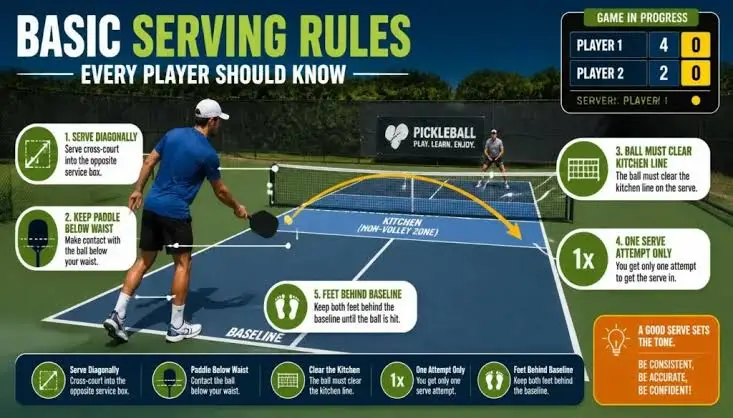
Some pickleball formats and competitions experiment with rally scoring, where a point can be awarded after every rally regardless of which team served.
This can make scoring more intuitive for people familiar with sports such as volleyball.
However, traditional side-out scoring remains deeply associated with pickleball.
Whether rally scoring is easier depends largely on the player’s experience and the format being used.
Is Forgetting the Score a Sign of Poor Concentration?
Usually, no.
Occasionally forgetting the score is completely normal during pickleball.
Players are processing movement, strategy, ball speed, positioning, communication, and decision-making simultaneously.
The score represents only one small piece of information.
If four players occasionally look at each other and ask, “What was the score?” it does not necessarily mean anyone was paying poor attention.
It often means everyone was focused on playing the point.
The Easiest Scorekeeping Habit
If you want one simple rule to remember, use this:
Always announce the score before serving.
This single habit prevents a large percentage of scoring confusion.
It gives the server a moment to remember the situation and allows the other three players to confirm that they agree.
If something is wrong, it can be corrected before another rally makes the situation even more confusing.
Final Review
So why do pickleball players forget the score?
It is usually a combination of the game’s scoring structure and the mental demands of playing.
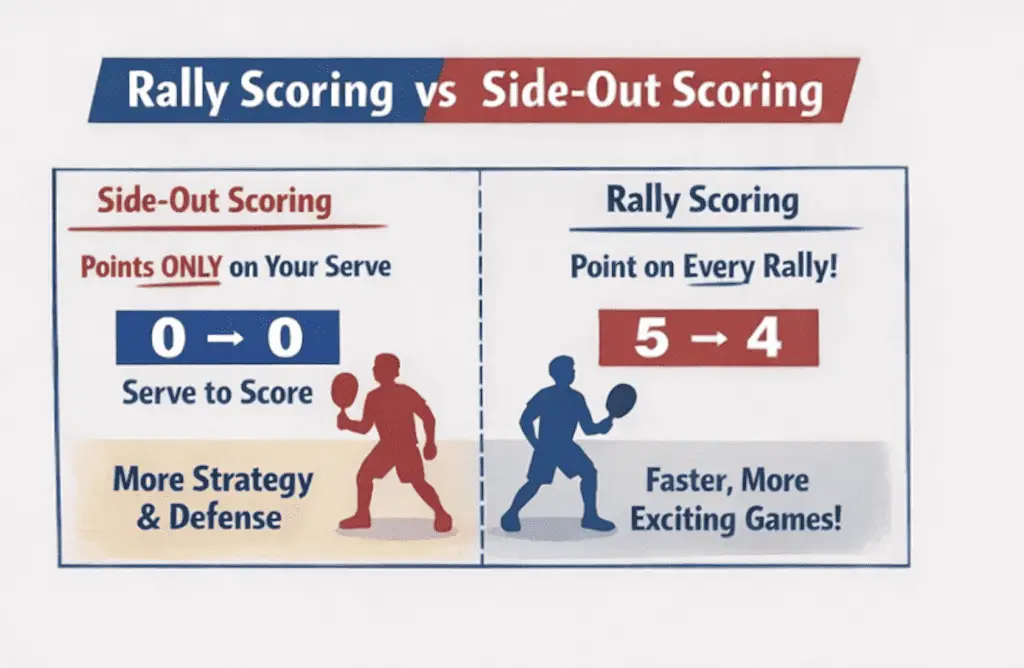
The three-number doubles score requires players to remember both points and server order. Side-out scoring means several rallies may occur without the score changing. Long rallies, conversations, fatigue, and court-position changes can make things even harder.
The good news is that scorekeeping becomes much easier with experience.
Players who announce the score clearly, understand odd-even positioning, and mentally track service changes rarely stay confused for long.
And if everyone forgets the score occasionally?
That is simply one of those surprisingly common parts of playing pickleball.
READ ALSO: What Equipment is Needed to Play Pickleball?

Harry is a freak who often argues that O in his name may well stand for “Obsessed with Pickleball.”
- Best pickleball shoes for women - September 25, 2026
- Why Pickleball Players Forget the Score? - September 1, 2026
- What Equipment is Needed to Play Pickleball? - August 3, 2026