
Pickleball court lines look simple at first, but understanding them is essential for playing correctly, avoiding faults, and building a proper court at home.
This guide covers:
- Official court dimensions
- Every line explained
- Kitchen/non-volley zone rules
- Singles vs doubles boundaries
- Colors and layout tips
- Indoor vs outdoor courts
- Common beginner mistakes
- Court tape and DIY options
Official Pickleball Court Dimensions
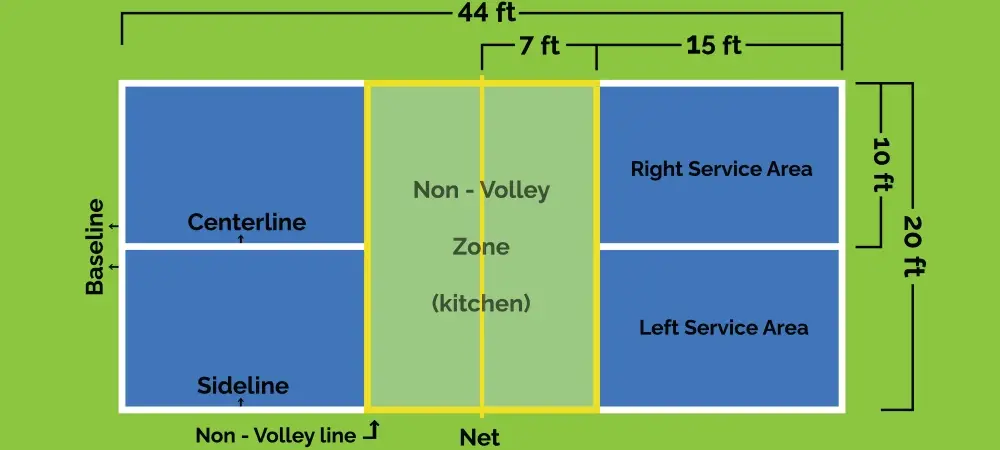
A standard pickleball court is:
- 20 feet wide
- 44 feet long
This is the same size for:
- Singles
- Doubles
The court is roughly the same size as a badminton doubles court.
Basic Layout

The court contains:
- Baselines
- Sidelines
- Centerline
- Non-volley zone line (“kitchen line”)
- Service courts
Every Pickleball Court Line Explained
1. Baseline
The baseline is the line at the very back of the court.
Purpose
- Marks the back boundary
- Servers must stand behind it while serving
Important Rule
You cannot step on the baseline during a serve.
Common Mistake
Beginners often accidentally touch the baseline with their foot during serving.
2. Sidelines
Sidelines run along the left and right sides of the court.
Purpose
- Define side boundaries
- Used for both singles and doubles
Unlike tennis:
- Pickleball uses the SAME sidelines for singles and doubles.
3. Centerline
The centerline divides each side into:
- Left service court
- Right service court
Purpose
Used during serves to determine:
- Correct serving position
- Correct receiving area
The serve must land diagonally across the net.
4. Non-Volley Zone Line (“Kitchen Line”)
This is one of the most important lines in pickleball.
The kitchen line sits:
- 7 feet from the net on both sides
The entire area between the net and this line is called the:
Non-Volley Zone (NVZ)

Kitchen Rules
You cannot volley the ball while:
- Standing in the kitchen
- Touching the kitchen line
- Falling into the kitchen after a volley
Why It Exists
The kitchen prevents aggressive net smashes and keeps rallies longer.
Are Court Lines “In” or “Out”?
In pickleball:
- A ball touching ANY part of a line is considered IN
This includes:
- Baseline
- Sideline
- Centerline during serves
- Kitchen line (except on serves)
Special Serve Rules
During a Serve:
The serve must:
- Land beyond the kitchen line
- Land inside the correct diagonal service box
Important:
If the serve touches the kitchen line:
- It is a fault
This catches many new players.
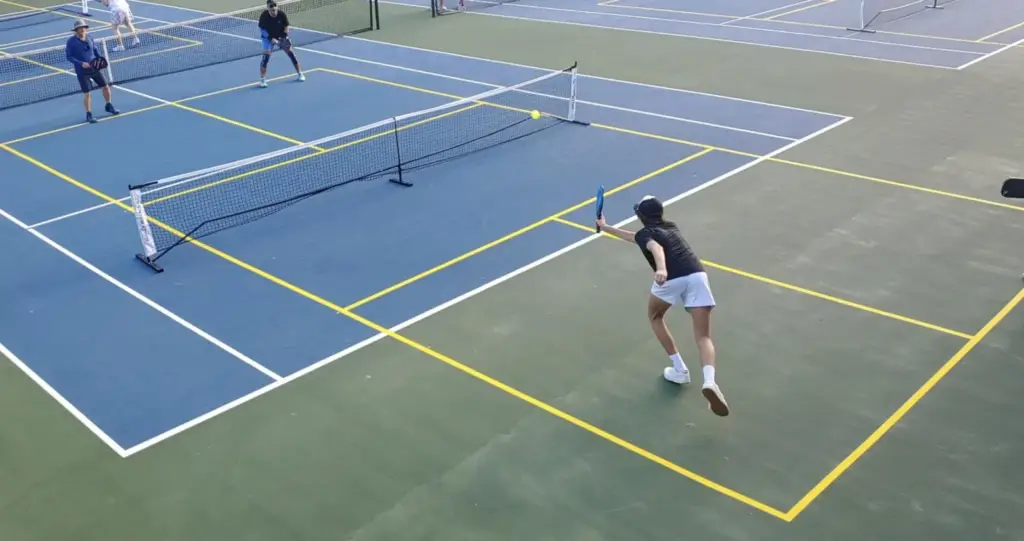
Court Line Colors
Pickleball lines are commonly:
- White
- Yellow
- Blue
- Light green
Indoor gyms often use multiple sports lines, which can get confusing.
Popular Court Color Combinations
Outdoor Courts
- Blue playing area
- Green outer area
- White lines
Indoor Courts
- Wood floor
- Tape lines

Line Width Requirements
Official pickleball line width:
- 2 inches wide
This helps visibility and consistency.
Temporary vs Permanent Court Lines
Temporary Court Lines
Used for:
- Driveways
- Gyms
- Multi-use courts
Usually made with:
- Court tape
- Chalk
- Portable markers

Pros
- Easy to remove
- Cheap

Cons
- May become slippery
- Less accurate
- Can peel
Permanent Court Lines
Painted directly onto:
- Asphalt
- Concrete
- Acrylic sport surfaces
Pros
- Better traction
- Professional look
- Durable
Cons
- More expensive
- Permanent
Indoor vs Outdoor Line Differences
The dimensions stay the same, but the surfaces change.
Indoor Courts
Usually:
- Smoother
- Faster ball bounce
- Tape-based lines
Outdoor Courts
Usually:
- Rougher texture
- Wind affects play
- Painted lines
Common Beginner Confusions
“Can I step in the kitchen?”
Yes — just not while volleying.
You may enter the kitchen:
- After the ball bounces
- During dinks
- When not volleying
“Is the kitchen line part of the kitchen?”
Yes.
Touching the line counts as touching the kitchen.
“Can serves land on the centerline?”
Yes.
A serve touching the centerline is IN.
“Can serves land on the kitchen line?”
No.
That is a fault.
DIY Pickleball Court Line Tips
If you’re creating a home court:
Best Surfaces
- Concrete driveway
- Asphalt
- Sport tiles
Best Marking Options
- Painter’s tape (temporary)
- Court tape
- Acrylic court paint
Recommended Setup
Measure carefully:
- 20 ft × 44 ft
- 7 ft kitchen zones
- Centered net
Pickleball Court Line Checklist
Court Must Have:
✅ Baselines
✅ Sidelines
✅ Centerline
✅ Kitchen lines
✅ 7-foot non-volley zones
✅ 2-inch-wide visible lines
Crowall Surface Contractors
Final Thoughts
Pickleball court lines are simple once you understand their purpose:
- Baselines control depth
- Sidelines control width
- Centerline controls serving direction
- Kitchen lines create strategic play
Most beginner mistakes happen around:
- Kitchen violations
- Serving line faults
- Misunderstanding which lines count as “in”
Learning the lines properly makes the game much easier and far more enjoyable.
READ ALSO: What is pickleball clinics?

Harry is a freak who often argues that O in his name may well stand for “Obsessed with Pickleball.”
- Best pickleball shoes for women - September 25, 2026
- Why Pickleball Players Forget the Score? - September 1, 2026
- What Equipment is Needed to Play Pickleball? - August 3, 2026