
Pickleball backhand is often the shot players struggle with the most — but with the right technique, footwork, and strategy, it can become your safest and most versatile weapon.
What Is a Backhand in Pickleball?
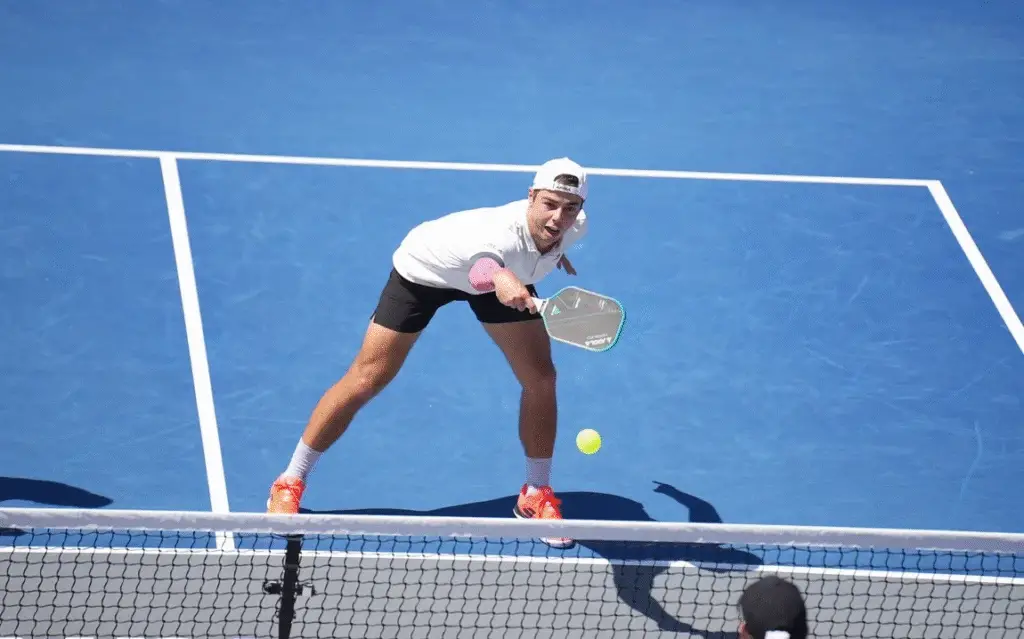
A backhand is any shot you hit with the paddle on the opposite side of your dominant hand:
- If you’re right-handed, your backhand is on the left side of your body.
- If you’re left-handed, your backhand is on the right.
You can hit:
- Backhand drives
- Backhand dinks
- Backhand volleys
- Backhand blocks
- Backhand rolls
- Backhand drops
When to Use the Backhand
A strong backhand helps you:
✔ Cover more court without switching grips
✔ Win kitchen-rally exchanges
✔ Block fast drives
✔ Counterattack at the net
✔ Control dinks on your weak side
✔ Hit drop shots with consistency
In advanced play, your backhand becomes your control shot.
Backhand Mechanics (Step-By-Step)
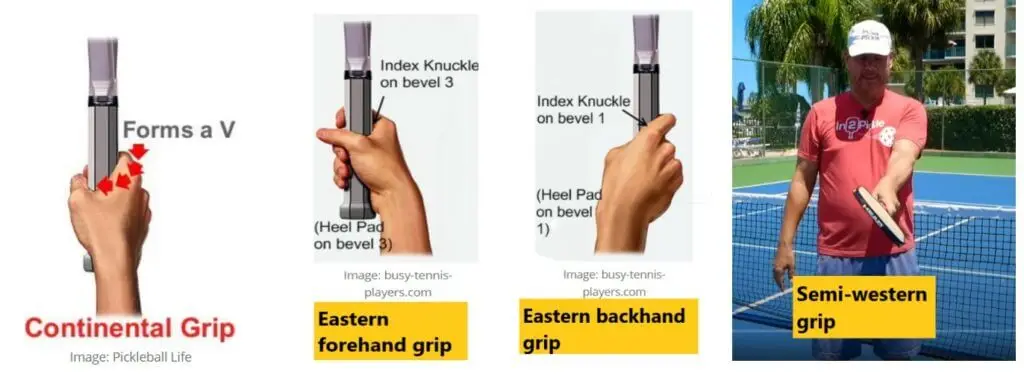
1️⃣ Grip
Use continental grip (“shake hand grip”):
- Versatile for dinks, volleys, blocks and rolls
- No grip switching needed
- Helps absorb pace on defense
How to find it:
Place the paddle face on your non-dominant hand and “shake hands” with it.
2️⃣ Stance & Preparation
- Stay in athletic stance: knees bent, paddle in front
- Shoulders slightly forward
- Paddle head above your wrist
Turn your shoulders BEFORE the ball arrives — this is the biggest key to a strong backhand.
3️⃣ Backswing
Keep it short and compact:
- Pivot shoulders, not the elbow
- Paddle stays close to your body
- Minimal wrist movement
4️⃣ Contact Point
For most backhands:
- Ball should be out in front of your body
- Paddle face slightly open (for dinks or drops)
- Keep elbow close but not locked
For drives:
- Paddle is more closed
- Contact slightly further out
5️⃣ Follow-Through
- Finish toward your target
- Smooth, not exaggerated
- Return quickly to ready position
🥇 Types of Backhands (Explained & Reviewed)
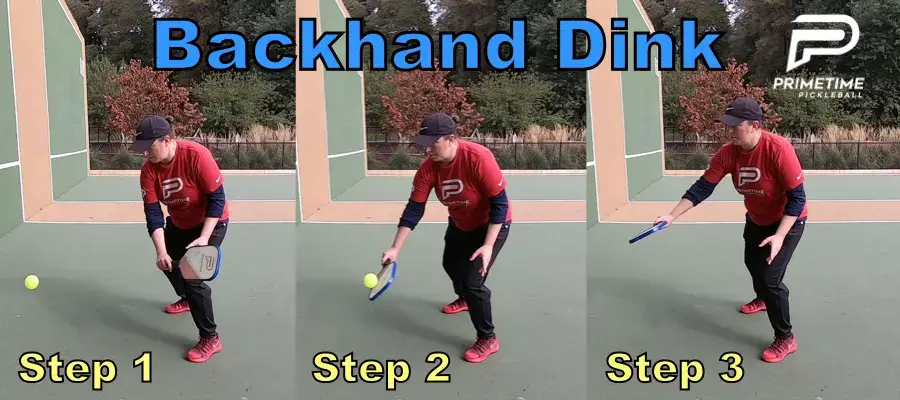
✔ 1. Backhand Dink (★★★★★ Essential)
Your most common backhand.
What it does: Controls the pace at the kitchen.
How to do it: Open paddle face lightly, push forward, no big swing.
✔ 2. Backhand Drive (★★★★☆ Offensive)
Used against high or attackable balls.
What it does: Creates pressure and sets up a volley.
Key: Short swing + body rotation.
✔ 3. Backhand Volley (★★★★★ Critical Skill)
Used at the kitchen line against fast shots.
What it does: Stops speed-ups & redirects pace.
Key: Punch forward, don’t swing.
✔ 4. Backhand Block (★★★★★ Defensive Weapon)
Top players rely heavily on this.
What it does: Defuses hard drives.
Key: Loosen grip to absorb energy.
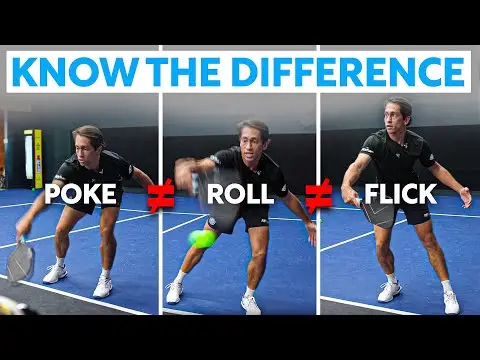
✔ 5. Backhand Roll (★★★★☆ Advanced)
A mini topspin flick from the wrist.
What it does: Surprise attacks at the kitchen.
Key: Brush up the ball → short follow-through.
✔ 6. Backhand Drop (★★★★☆ Soft & Accurate)
Used in transition.
What it does: Turns a fast rally into a slow one.
Key: Slightly open face + short push.
🧪 Common Backhand Mistakes (and Fixes)
| Mistake | Why It Happens | Fix |
|---|---|---|
| Swinging too big | Tennis habits | Compact motion, shoulder turn only |
| Contact too far back | Late reaction | Prepare paddle early |
| Overusing wrist | Lack of control | Stabilize wrist, use arm + shoulder |
| Standing upright | No stability | Bend knees and stay low |
| Hitting from the side | No rotation | Turn shoulders before ball arrives |
The #1 Secret: Early Preparation
90% of weak backhands come from late shoulder turn.
If you turn early, the stroke becomes easy, controlled, and repeatable.
Best Drills for Improving Your Backhand
🥤 1. Wall Backhand Drills
Hit 50–100 continuous backhand shots against a wall:
- Soft dinks
- Firm drives
- Alternating speeds
🎯 2. Target Practice
Place cones or small squares across the court.
Aim for:
- Deep cross-court drives
- Soft drops into the kitchen
- Volleys to the opponent’s feet
🚶 3. Transition Drops
Start from the baseline → walk forward while hitting backhand drops into the kitchen.
⚡ 4. Speed-Up → Block
Partner speeds up a ball to your backhand.
You block back softly.
Improves reaction time & stability.
🧩 5. Backhand Volley Battles
Kitchen-to-kitchen fast volley exchanges.
This builds elite net-handling skills.
🏓 Paddle Recommendations for Better Backhands
✔ For Control (easier backhands)
- Selkirk Vanguard 2.0
- Joola Perseus (control version)
- CRBN 1X
✔ For Power & Roll Spin
- Joola Ben Johns Hyperion
- SixZero Double Black Diamond
- Vatic Pro Prism Flash
✔ For Beginners
- Onix Z5
- Paddletek Phoenix G6
Control-oriented paddles make backhand dinks, blocks, and drops significantly easier.
🧠 Strategy Tips (Beginner → Advanced)
Beginner
- Use your backhand to keep the rally neutral
- Don’t attack low balls
- Keep paddle high and compact
Intermediate
- Add soft roll attacks on high dinks
- Block fast balls to opponent’s feet
- Hit deep cross-court backhand returns
Advanced
- Use disguise: look like a dink → flick
- Attack inside foot weak spots
- Speed-up → ready to counter
⭐ Final Review
| Category | Rating |
|---|---|
| Difficulty | Moderate |
| Consistency Potential | ★★★★★ |
| Usefulness at Kitchen | ★★★★★ |
| Offensive Value | ★★★★☆ |
| Defensive Value | ★★★★★ |
READ ALSO: What does side out mean in pickleball?

Harry is a freak who often argues that O in his name may well stand for “Obsessed with Pickleball.”
- When does a rally end in pickleball? - January 12, 2026
- Pickleball rules doubles - December 16, 2025
- How important is the Pickleball backhand? - November 18, 2025